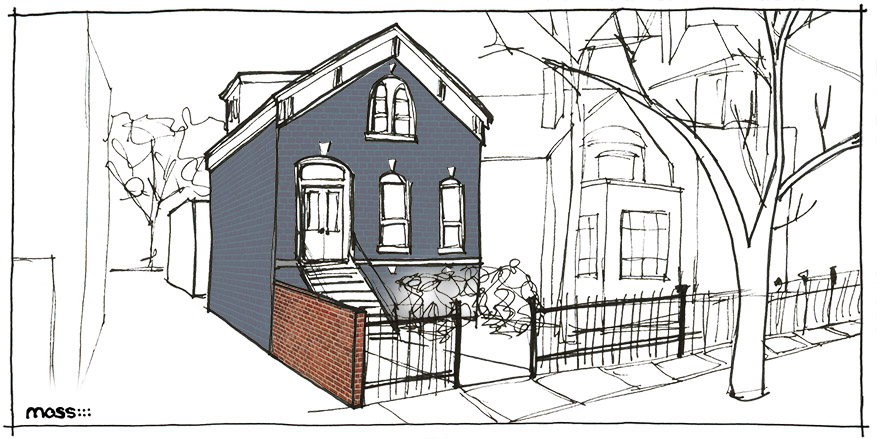
When homeowners ask, “What is brick veneer?” they’re often surprised to learn that most modern brick houses aren’t built with solid, structural brick. Instead, they feature a thin outer layer of brick, essentially an aesthetic wrapper, attached to a wood-framed wall. This outer wythe doesn’t hold up the house; it simply hangs on the structure like a jacket. Behind it sit the real working layers: framed walls, insulation cavities, and air/water barriers.
In short, many contemporary homes marketed as “brick” are actually brick-veneered. Understanding the difference matters, especially for sustainability-driven homeowners looking to improve efficiency, explore natural refrigeration methods, or incorporate passive cooling design strategies like those offered by Chicago architecture firm moss Design.
Brick Veneer House Exteriors — Pros & Cons
Pros
Familiar aesthetic
Many Chicago area neighborhoods were built with masonry, so brick veneer is often used to echo classic streetscapes. When people ask, “What is brick veneer?” this comfort factor is usually what they’re really after.
Marketing value
A “brick home” still carries prestige, even if the brick is only a single non-structural layer.
Durability + low maintenance
Brick holds up well to freeze–thaw climates, requires little upkeep, and ages gracefully.
Fire resistance
Brick veneer can add a measure of resilience and peace of mind.
Cons
It’s not structural
All structural loads fall on the wood-framed interior, which means the brick is not providing the thermal or structural benefits historically associated with solid masonry.
Limited insulation value
Brick veneer does not meaningfully increase R-value.
Adds cost without a performance benefit
You pay for brick but don’t gain the true benefits of masonry mass.
Reduces thermal mass functionality
This is the key concept: brick is an excellent thermal storage material, but when it’s placed outside the insulation layer—as in a veneer system—it cannot stabilize interior temperatures. The mass is effectively wasted.
Brick Veneer vs. Solid Brick
Solid brick construction is load-bearing and relies on thick masonry walls that provide substantial thermal mass. When sunlight heats the masonry, the walls slowly absorb and release that energy over time, naturally regulating temperature, an ancient principle underlying passive cooling design, low-energy cooling systems, and even early forms of sustainable refrigeration in historic architecture.
Brick veneer, by contrast, is non-load-bearing. The brick sits outside the insulation, disconnected from the interior. It may look the same, but it performs entirely differently.
Why this matters: the placement of thermal mass affects comfort, heating/cooling loads, and long-term energy performance, especially in Chicago’s variable and often harsh climate.
Why Brick Veneer Falls Short in Sustainable Design
From a sustainability standpoint, brick veneer is mostly aesthetic and often not considered a good sustainable practice. The veneer adds weight, cost, and materials but contributes very little to thermal performance. Because the insulation sits behind the sheathing, the masonry never interacts with indoor temperatures. So even though brick is a phenomenal natural thermal regulator and has been historically relied upon in natural refrigeration methods, thick-stone cellars, and off-grid refrigeration strategies, we lose these benefits entirely in a veneer assembly.
For Chicago architecture firm moss Design, performance always matters more than appearance, so understanding materials and their capacities is essential.

Understanding Thermal Mass in Architecture
Thermal mass regulates temperature by absorbing heat during the day and releasing it slowly at night. In energy-conscious homes, it works hand in hand with insulation, shading, glazing, and passive solar orientation.
Key principles:
- Thermal mass must be inside the insulated envelope to impact interior comfort.
- Thermal mass is ideal for passive heating and cooling, helping reduce reliance on mechanical systems.
- In Chicago, where winters are freezing and summers are hot and humid, thermal mass helps smooth out dramatic temperature swings.
Masonry, concrete, and other dense materials have long been used to maintain comfort and even support low-energy cooling systems before mechanical cooling was common.
A Better Alternative: Inverting the Wall Assembly
Moss Design’s architectural design Chicago architects often recommend “inverting” the typical wall system to place the masonry mass inside, rather than outside, the insulated layer.
This project has an interior thermal mass masonry wall, if you’d like to reference a project. https://moss-design.com/new-home-construction-goes-gourmet-with-dual-kitchens/
This house as well https://moss-design.com/project/cedar-house-among-the-trees/
This approach creates a high-performance envelope with real thermal benefit:
- The mass is exposed to interior conditions.
- Temperatures stay more stable throughout the day.
- Heating and cooling loads drop significantly.
- The wall performs more consistently through Chicago’s seasons.
This strategy parallels principles behind vernacular off-grid refrigeration and pre-electric sustainable refrigeration techniques, where thermal mass was used to stabilize temperature naturally.
Chicago Case Study: LEED Home in Ravenswood
One of moss Design’s most celebrated residential projects uses this inverted assembly. The wall reaches approximately R-35, combining continuous exterior insulation, airtight construction, and interior concrete mass. Paired with high-performance windows and a calibrated glazing strategy, this creates a significantly more stable, comfortable interior environment.
The result: year-round energy savings, reduced reliance on mechanical heating and cooling, and a quieter, more resilient home. For any residential architect Chicago, this project demonstrates how “What is brick veneer?” becomes a much larger conversation about how materials serve comfort.
Passive Solar Design + Wall Thermal Mass
Pairing thermal mass with thoughtful glazing makes the system even more effective.
- South-facing windows capture winter sun.
- Overhangs and shading devices block unwanted summer heat.
- Interior mass walls absorb solar gains during the day and release them in the evening, keeping indoor temperatures steady.
These techniques align with the same principles behind passive cooling design and low-energy cooling systems, naturally reducing peak loads.
Alternative Sustainable Wall Materials
With some of the best architects in Chicago, moss Design works across many material systems, selecting each based on performance, durability, aesthetics, and environmental impact.
Options include:
Concrete masonry units
They are durable and high-mass, making them effective when placed inside insulation.
Rammed earth
It has extremely high thermal mass and low embodied energy.
Cavity masonry
This structural masonry features an internal air gap that is excellent for mass and moisture control.
Straw-bale construction
It is super-insulated, low-carbon, and ideal for thick walls.
Salvaged or upcycled masonry
It reduces the carbon footprint and brings textural richness and history to the project.
When Brick Veneer Still Makes Sense
While moss Design prioritizes performance, brick veneer can be appropriate in certain residential architect Chicago contexts:
- Historic fabric or vernacular continuity in Chicago neighborhoods
- Zoning or HOA constraints that require brick street frontage
- Aesthetic preferences or resale considerations
- Budget alignment when clients want the look of masonry without full structural construction
Used thoughtfully and without overstating its performance, brick veneer can serve specific design goals.
Moss Design’s Approach to Sustainable Wall Design
At moss Design, architectural design Chicago material choices are rooted in performance, not trend. The studio integrates passive strategies early, optimizing wall assemblies for:
- Thermal comfort
- Envelope efficiency
- Reduced operational energy
- Climate-resilient design
- Long-term durability
- Weather and moisture barrier
From Ravenswood to Logan Square to Evanston, residential architect Chicago firm moss Design continues to evolve wall systems that balance beauty, rigor, and innovation in projects.
Build Sustainably With moss Design
Understanding what is brick veneer helps homeowners make informed, sustainable design decisions. Brick veneer is primarily aesthetic and offers limited performance benefits, especially compared to assemblies that use thermal mass effectively. Placing masonry inside the insulated envelope honors the material’s natural strengths and elevates the energy performance of the home. If you’re planning a renovation or new build, Chicago architecture firm moss Design can help you explore high-performance wall assemblies, passive cooling strategies, and sustainable alternatives to brick veneer.
Reach out to some of the best architects in Chicago at moss Design to explore custom, climate-responsive wall designs tailored to your Chicago home.

Frequently Asked Questions
What is brick veneer, and how does it differ from solid brick construction?
Brick veneer is a non-structural layer of brick attached to the exterior of a wood- or steel-framed wall. Unlike traditional solid brick walls that carry structural loads, a brick veneer acts purely as a cladding system. It provides the appearance of masonry without serving as a load-bearing wall. Within the landscape of architecture firms Chicago, it is known that while brick veneer offers aesthetic appeal, it does not utilize brick’s natural thermal mass benefits unless placed on the interior side of the insulation.
Is brick veneer a good choice for Chicago residential architecture?
Brick veneer is common in Chicago residential architecture because it’s lightweight, cost-effective, and visually compatible with the city’s historic masonry character. However, for homeowners seeking high performance, Chicago residential architecture firms may recommend alternative wall assemblies that better leverage thermal mass, reduce heat loss, and improve energy efficiency—especially in Chicago’s harsh winters.
Why do some architecture firms Chicago is home to advise against relying solely on brick veneer?
Some architecture firms Chicago is home to caution that brick veneer is often used as ornament rather than for performance. Because the brick layer sits outside the insulation, it cannot regulate indoor temperature effectively. For climate-responsive design, architectural design Chicago experts often prefer interior masonry or high-performance wall systems that take full advantage of thermal mass, moisture control, and energy savings.
What are the benefits and drawbacks of using brick veneer on modern homes?
The benefits of brick veneer include lower cost, reduced structural load, and classic curb appeal. Drawbacks include limited thermal performance and the risk of moisture issues if not properly detailed. The best architects in Chicago often design hybrid systems—pairing brick veneer with improved insulation, rain screens, or interior masonry—to balance aesthetics with long-term durability and comfort.
How can Chicago area architects improve energy efficiency when using brick veneer?
Chicago area architects improve energy efficiency by designing “reverse wall” assemblies, placing masonry or concrete block on the interior for thermal mass and using high-performance insulation on the exterior. This approach allows the wall to absorb and release heat naturally—an effective strategy for Chicago’s temperature swings and a principle frequently used by the top residential architecture firms Chicago has to offer.