


Rethinking how we cool our homes and store food has never been more important. As global temperatures rise and energy consumption spikes, architects and designers are reexamining low-energy and natural refrigeration methods that predate today’s carbon-heavy appliances. One of the most surprising contributors to this conversation is Albert Einstein, whose work on the Einstein refrigerator continues to inspire a new wave of sustainable thinking. For a leading Chicago architecture firm like moss Design, which has been recognized among the best architects in Chicago, these historical innovations offer rich lessons on how to build more resilient and sustainable homes.

Why Refrigeration Needs Reinvention
Refrigeration accounts for roughly 15% to 20% of household energy use in the U.S., making it one of the most persistent sources of electricity demand. As climate change intensifies heatwaves across cities, cooling loads continue to rise, creating a feedback loop of higher energy use and greater carbon emissions.
This is why architecture firms must take an active role in rethinking the systems embedded in homes. In the world of Chicago residential architecture, these questions guide decisions about enclosure design, materiality, airflow, and mechanical systems; factors that shape a building’s long-term environmental impact. When a residential architecture firm explores alternatives to energy-intensive appliances or designs homes that reduce reliance on mechanical cooling, the result is healthier homes and more sustainable urban neighborhoods.

The Einstein Refrigerator — How It Works
The Einstein refrigerator stands as one of the most intriguing historical attempts to reimagine cooling without electricity.
The Origins — Einstein + Leo Szilard
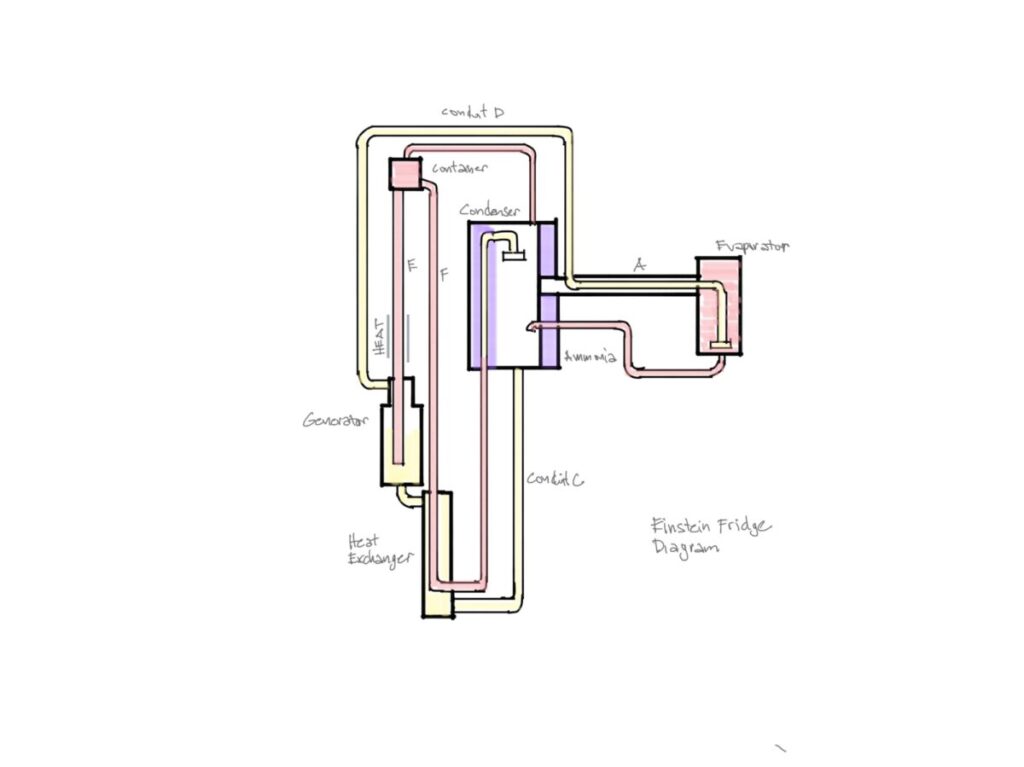
Developed in 1926 by Albert Einstein and physicist Leo Szilard, the Einstein refrigerator was created in response to a tragic accident involving toxic fumes from early ammonia-based fridges. Their goal: develop a safer, more stable, and electricity-free cooling device.
Using only a heat source and a clever combination of sealed gases, Einstein and Szilard produced a refrigerator with no moving parts, reducing the risk of leaks while increasing the unit’s functional lifespan.
How the Einstein Fridge Works
Instead of a compressor, the design uses pressurized gases—typically butane, ammonia, and water—to generate cooling through changes in pressure. When the heat source warms one chamber, a gas is vaporized, expands, and drives the cooling cycle in another chamber. The absence of moving parts makes the Einstein refrigerator almost silent, remarkably durable, and dramatically safer than the ammonia-based models common at the time.
Modern Rediscovery
Interest in the Einstein refrigerator has resurfaced as designers explore solar-powered versions, carbon-neutral prototypes, and off-grid applications. In remote communities and developing regions, its no-electricity cooling model offers both resilience and reduced environmental impact. For architects, these rediscoveries underscore how alternative cooling technologies can influence architectural design today.
The “Pot Within a Pot” — Off-Grid Cooling in Practice
In the 1990s, Nigerian inventor Mohammed Bah Abba revived evaporative cooling with his “Zeer Pot,” or pot-within-a-pot refrigerator. Two clay pots, one nested inside the other, are separated by water-saturated sand. As water evaporates, it cools the inner chamber, extending the shelf life of produce by days or weeks.
The thermodynamics are elegantly simple: evaporation draws heat outward, reducing the temperature inside. This innovation improved food security and education for rural communities with limited electricity access. From moss Design’s perspective, it demonstrates how low-tech, local-material solutions can influence sustainable design thinking within Chicago residential architecture, encouraging architects to consider off-grid strategies even in urban contexts.
Biopolymer Gel Cooling: The Bio Robot Concept
Yuriy Dmitriev’s Bio Robot Refrigerator uses a non-electric biopolymer gel that absorbs heat through bio-luminescent, viscous material. Instead of mechanical cooling, the gel suspends food items in individual pods, isolating and cooling them without refrigeration coils.
While conceptual, this system represents the kind of future-minded sustainable technologies that Chicago-area architects and forward-thinking studios like moss Design are increasingly interested in. It hints at decentralized cooling, customizable storage, and reduced energy loads—ideals that align with low-energy urban living.
Sand-Based Root Cellar Systems
Designer Jihyun Ryou’s work revisits traditional root cellar methods by using sand, humidity control, and ethylene-balancing strategies. Her famous apple-and-potato pairing stabilizes freshness by allowing apples (which produce ethylene gas) to slow potato sprouting.
Root cellars offer humidity stabilization and passive cooling without electricity, an essential lesson for small-space living and sustainable food storage. For a Chicago architecture firm attuned to dense urban environments, these strategies offer ways to rethink pantry design, basement use, and environmental control.
Outback Cooler: Portable Natural Refrigeration
Used in remote areas of Australia, the Outback Cooler is a portable evaporative system made of metal mesh, canvas, and sand. By harnessing airflow and water evaporation, it can keep food cool even in harsh climates.
Its value lies in material efficiency and energy conservation, qualities that inform moss Design’s work with local materials and site-responsive solutions.

Lessons for Sustainable Residential Architecture
This is where historical cooling meets modern design. For moss Design, these innovations provide a foundation for sophisticated, low-energy cooling systems that benefit homeowners.
Key takeaways include:
- Passive cooling design inspired by evaporative and pressure-based systems
- Materiality + thermal mass strategies using masonry or rammed earth
- Low-energy cooling systems that reduce dependence on mechanical cooling
- Integrated food-storage design inspired by root cellars and decentralized cooling
- Relevance to net-zero homes where energy reduction is key
In our architectural design work, we incorporate passive solar orientation, natural ventilation, and local material sourcing to reduce operational energy use, which is why many consider us among the best architects in Chicago.

How Architects Can Incorporate Passive Cooling Strategies
Architects can design homes that stay naturally comfortable through:
- Orientation that maximizes shade and minimizes heat gain
- Thermal-mass walls that absorb and slowly release heat
- Cross-ventilation layouts that create natural airflow
- Courtyard cooling that lowers indoor temperatures
- Green roofs that buffer heat and manage rainfall
For architecture firms in Chicago, the dense urban context adds complexity, but also opportunity. Thoughtful massing, urban shading, and natural ventilation become even more valuable.

Case Studies from moss Design
Over the years, moss Design has implemented passive solar strategies, salvaged material use, and custom ventilation solutions in numerous projects. Our net-zero-leaning residential designs showcase how low-energy systems, durable materials, and biophilic strategies can coexist beautifully within Chicago residential architecture. As Chicago-area architects, we continually adapt lessons from history to address urban living challenges.
Future of Sustainable Refrigeration
The future of cooling will blend the wisdom of the past with new material science. Decentralized food storage, hybrid passive-mechanical systems, and renewable-powered refrigeration will shape residential design. For every residential architect in Chicago, integrating these ideas is key to climate-responsive practice.
From the Einstein refrigerator to evaporative pots and futuristic gel-based systems, sustainable refrigeration continues to evolve. Einstein’s insights still influence sustainable design thinking today, reminding us that innovation often begins with simplicity. If you’re ready to explore environmentally responsible design, from passive cooling design to net-zero strategies, moss Design is here to guide the way. Contact us today to work with one of our architects on your environmentally responsible design.

Frequently Asked Questions
What is the Einstein refrigerator, and why is it considered a sustainable cooling system?
The Einstein refrigerator is a 1926 invention by Albert Einstein and Leo Szilard that uses heat and pressurized gases instead of electricity or mechanical compressors to create cooling. Because it has no moving parts, requires minimal energy, and avoids harmful refrigerants, it is viewed as an early model of sustainable refrigeration and a precursor to today’s low-energy cooling systems.
How do natural refrigeration methods like the Einstein refrigerator compare to modern electric fridges?
Modern refrigerators rely on electricity and chemical refrigerants, whereas natural refrigeration methods, including the Einstein refrigerator, pot-in-pot coolers, biopolymer gel concepts, and root-cellar systems, use passive thermodynamic processes such as evaporation, heat absorption, and pressure changes. These off-grid refrigeration options consume far less energy and reduce environmental impact, making them appealing for sustainable home design.
Can passive cooling or low-energy refrigeration systems work in urban homes?
Yes. Passive cooling systems can be integrated into urban homes through architectural choices such as thermal-mass walls, improved ventilation paths, shaded courtyards, and decentralized food-storage spaces. When combined with hybrid systems or solar-powered technology, natural refrigeration methods can significantly reduce mechanical cooling loads even in dense cities like Chicago.
What are the benefits of off-grid refrigeration methods for homeowners?
Off-grid refrigeration methods reduce reliance on electricity, lower utility costs, and provide resilience during outages or extreme weather. They also use natural processes that avoid the use of greenhouse-gas refrigerants. For environmentally focused homeowners, these systems support a more sustainable lifestyle and complement broader passive cooling design strategies.
How are architects using natural and low-energy cooling techniques in modern residential design?
Architects incorporate these techniques by designing homes with passive solar orientation, thermal mass storage zones, evaporative cooling features, natural ventilation, and materials that help stabilize indoor temperatures. These strategies reduce energy consumption and support climate-responsive design, making them valuable for any homeowner interested in sustainable architecture and low-energy living.
